U-PSD TREPR
A multifaceted research program: from advanced instrumentation to mechanistic studies.
The Story
I first met Professor Guo during the early days of my PhD. At the time, he was in the midst of developing the U-PSD TREPR—an invention he introduced to me with a palpable, infectious passion. I remember seeing a certain “spark” in his eyes that only comes from a true inventor’s belief in their work. That sincerity deeply moved me, and with Professor Jiao’s support, I began a collaboration that would redefine my research trajectory.
Initially, I played a supporting role, validating and fine-tuning the instrument’s specifications. Then came a challenge I never anticipated: Professor Guo asked me to develop the core data post-processing software. I felt a mix of being deeply flattered and incredibly nervous—the weight of the task was immense. After much deliberation, I committed to the project, building the initial framework in MATLAB and eventually refactoring it into C#. This software became the digital backbone for every experiment that followed.
What drew me to the U-PSD TREPR was its profound ability to “see” the unseen—the transient radicals that govern chemical life. Once the prototype was stable, we faced a defining question of research taste: what problem is significant enough to showcase this instrument’s true potential?
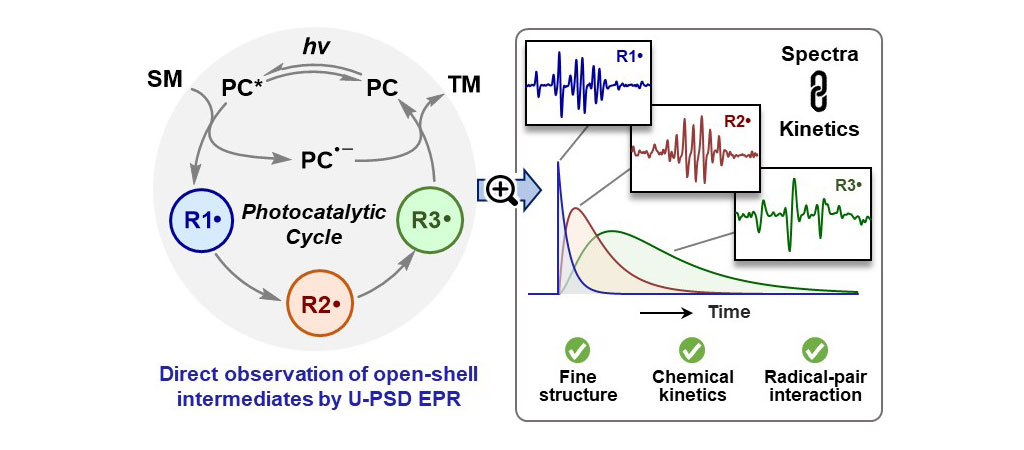
Our focus eventually shifted from preliminary studies to a high-stakes challenge: the direct, exhaustive observation of a complete photocatalytic cycle. I remember November 10, 2023, with total clarity. I was running an experiment on a complex Iridium-based system, and for the first time, I watched the simultaneous existence and mutual transformations of multiple radical intermediates unfold on my screen.
The excitement was overwhelming. Over the next 14 days, my co-first author Weiqun Suo and I lived in the lab. We ran the instrument 24/7, barely shutting it down, driven by the sheer adrenaline of capturing a mechanistic landscape that had never been seen in such detail. Since then, with a matured workflow and a more robust software suite, our collaboration has pushed the boundaries of the U-PSD TREPR even further, translating transient signals into rich, quantitative mechanistic insights.
Academic Summary
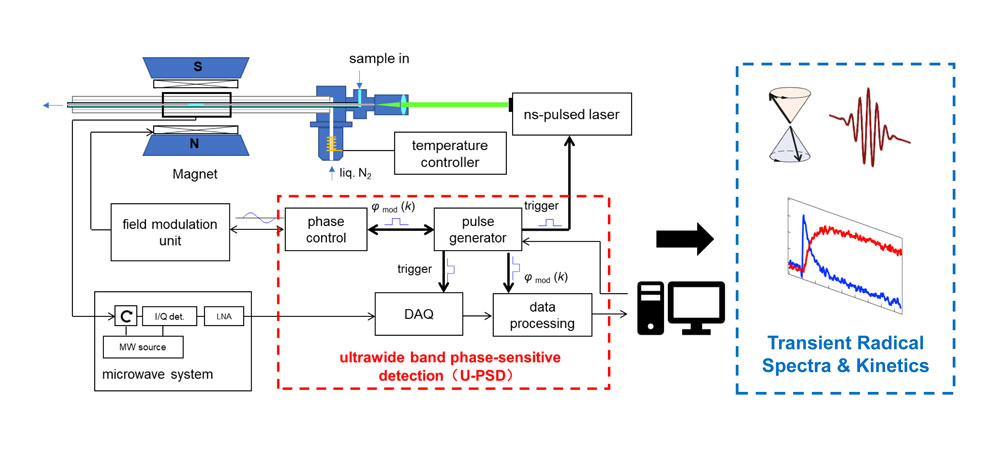
This research program establishes a robust paradigm for auditing complex open-shell processes by integrating innovative spectroscopic instrumentation with rigorous mechanistic investigations. The cornerstone of this work is the development of the Ultrawide Single Sideband Phase-Sensitive Detection (U-PSD) Time-Resolved EPR (TREPR) spectrometer.1 By employing a 100 kHz field modulation and a single-sideband demodulation algorithm, this instrument achieves a transient time resolution of 40 ns while maintaining exceptional sensitivity for radical species in thermal equilibrium. This technological breakthrough addresses the long-standing limitation of conventional TREPR in detecting non-polarized signals, providing the necessary hardware foundation for capturing the elusive, short-lived intermediates that govern modern catalytic cycles.
Leveraging the high-fidelity detection capabilities of the U-PSD platform, we achieved the first direct visualization of a complete photocatalytic cycle in the addition of amines to acrylates.2 The study identifies and monitors the evolution of all key open-shell intermediates, including the amine radical cation, the α-aminoalkyl radical, and the final radical adduct. By fitting experimental hyperfine splitting (HFS) constants and performing comprehensive kinetic simulations, we provided an unambiguous experimental validation of the redox-neutral catalytic cycle. This direct observation of intermediate transformation kinetics replaces speculative mechanistic models with a data-driven understanding of how radical flux is managed within a photoredox system.
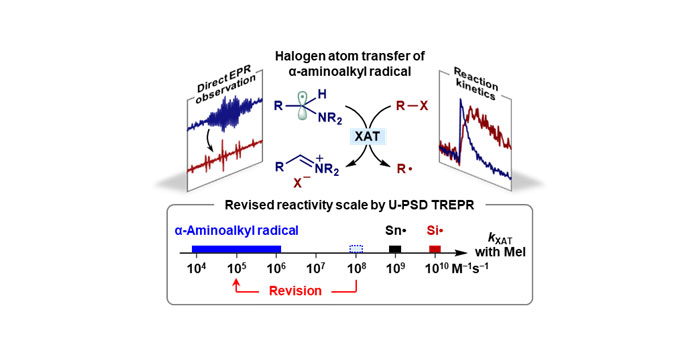
The precision of the U-PSD TREPR system further enabled a critical reassessment of the reactivity scales within radical chemistry. Specifically, we audited the Halogen Atom Transfer (XAT) reactivity of α-aminoalkyl radicals—intermediates previously thought to exhibit reactivity comparable to tin-centered radicals.3 Our kinetic measurements revealed that their true XAT rate constants are actually $10^3$ to $10^5$ times lower than previously estimated in the literature. Furthermore, solvent effect analysis and kinetic auditing demonstrated the absence of significant polar effects in the transition state, fundamentally revising the reactivity guidelines for the rational design of XAT-based catalytic methodologies.
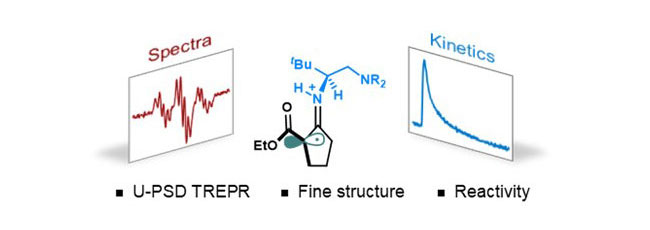
The scope of this methodology was extended to SOMO (Singly Occupied Molecular Orbital) catalysis in photoredox/chiral primary amine synergistic systems.4 We successfully characterized and monitored the transient enamine radical cation and its subsequent deprotonated form, the α-imino radical. The auditing process revealed a significant reactivity disparity between these two species, with the radical cation exhibiting an order of magnitude higher reactivity than its neutral counterpart. These findings highlight the decisive role of deprotonation in modulating the electronic properties and reaction rates of enamine-derived radicals. Collectively, these works demonstrate how customized instrumental development can resolve fundamental mechanistic ambiguities, providing quantitative depth to the field of physical organic chemistry.